
Workplace Agility: A State Agency Perspective
Linda A. Samples
Texas Tech University Health Sciences Center – El Paso
Article Published: June 2021
Click here for the full PDF copy
Telework, also referred to as “flexible” or “agile work,” has been on the rise for years and skyrocketed in the United States with the advent of COVID-19. Teleworking in state government agencies has increased by 122 percent since 2005.[1] While some employers already had remote/telework policies in place when COVID struck, others allowed employees to work remotely during COVID-19, without putting formal policies in place.
Even agencies that had a remote work policy in place before the pandemic might benefit from evaluating current policies and practices and charting the course forward as the pandemic subsides. This article highlights legal considerations when creating/updating flexible work policies.
Definitions
There is flexibility in “flexibility.” Generally speaking, a flexible work arrangement is any one of a spectrum of work structures that alters the time and/or place that work gets done on a regular basis.
A flexible work arrangement includes:
- Flexibility in the scheduling of hours worked, such as alternative work schedules (e.g., flex time and compressed workweeks) and arrangements regarding shift and break schedules;
- Flexibility in the number of hours worked, such as part-time work and job shares;
- Flexibility in the place of work, such as working at home or at a satellite location.[2]
In light of the myriad means of providing flexibility in the workplace, odds are that your client or state agency provides some means of flexible work.
Trends in Flexible Work Practices
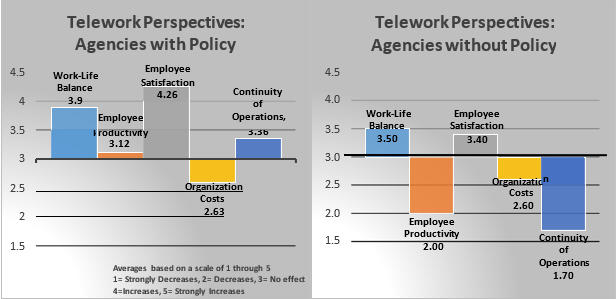
According to a 2014 survey by the Texas Department of Information Resources, 84 percent of state agencies and institutions of higher education have or are planning a telework policy.[3] The survey also found that perspectives on the efficacy of telework varies depending on whether or not an agency has a telework policy:
Comparison of Perspectives on Telework by Agency Representatives
With and Without Policy
Source: 2014 DIR Telework Survey[4]
If you already have a remote work policy, the heavy lifting likely has already occurred, and the extant policy should be assessed for updates needed to address issues that came to light during the pandemic or the considerations outlined herein. In the absence of a formal flexible work policy, notify employees that temporary allowances were made to accommodate the global pandemic and establish clear expectations for returning to work and/or allowing a post-pandemic flexible work environment. Informal remote work offerings should be formalized to set clear expectations for both employers and employees to mitigate future disputes. Note that even if your client or agency elects not to allow remote/telework, permitting an employee to work from home still might constitute a reasonable accommodation under the Americans with Disabilities Act.[5]
Unique State Agency Considerations
Texas law outlines the normal office hours for a state agency and allows the chief administrator of a state agency to modify the regular office hours if deemed necessary or advisable, or “to take care of any emergency or public necessity that the chief administrator finds to exist.”[6] The law also allows the governing boards of institutions of higher education or a university system to make exceptions to work-week and workday definitions, “to achieve and maintain operational efficiency at the institution of higher education, university system, or an office, department, or division of either.”[7]
Texas law requires state agency employees to conduct agency business only at the employee’s regular or assigned temporary place of employment unless the employee is travelling or received prior written authorization from the administrative head of the employment state agency.[8] The law expressly provides that:
The employee’s personal residence many not be considered the employee’s regular or
assigned temporary place of employment without prior written authorization from the
administrative head of the employing state agency.[9]
Accordingly, not only is a written agreement regarding remote work a good idea, it is legally required for state agency employees, and it may provide a defensive tool against a myriad of potential employment pitfalls. Upon surveying state agencies, the Texas Department of Information Resources found that those with successful telework programs stressed the importance of “setting clear and measurable goals and identifying and express[ing] expectations.”[10]
Which positions will be allowed to work remotely?
Each employer must assess the work that needs to get done and whether said work can be performed effectively and efficiently remotely. Working offsite can take many forms. Some considerations may include:
- Job Responsibilities—Not all positions are amenable to remote work. For example, some positions have a need for specialized materials or equipment that are available only at the work site. Some questions to consider are:
- Is the employee’s presence at the regularly assigned place of employment required on a daily or routine basis?
- The U.S. Department of Labor recommends a self-assessment of the following:[11]
- Sufficient portable work for the amount of telework proposed
- Comfort with the technologies, if any, that will be needed to telework
- Good communication with managers, co-workers, customers that will enable a relatively seamless transition from onsite to offsite
- Telework office space that is conducive to getting the work done
- Dependent care arrangements in place
- Ability to be flexible about the telework arrangement to respond to the needs of the manager, the work group and the work.
- The U.S. Department of Labor identifies the following habits of a successful teleworker:[12]
- Ability to work with minimal direct supervision
- Organized work practices, good planning skills
- Ability to meet schedules and deadlines
- Effective time management skills
- Effective communication skills
- Employee Performance—Does the employee have a history of performance that makes him/her suitable for remote work? Employers must remain cognizant of the uniform application of performance standards that disqualify employees from working remotely.
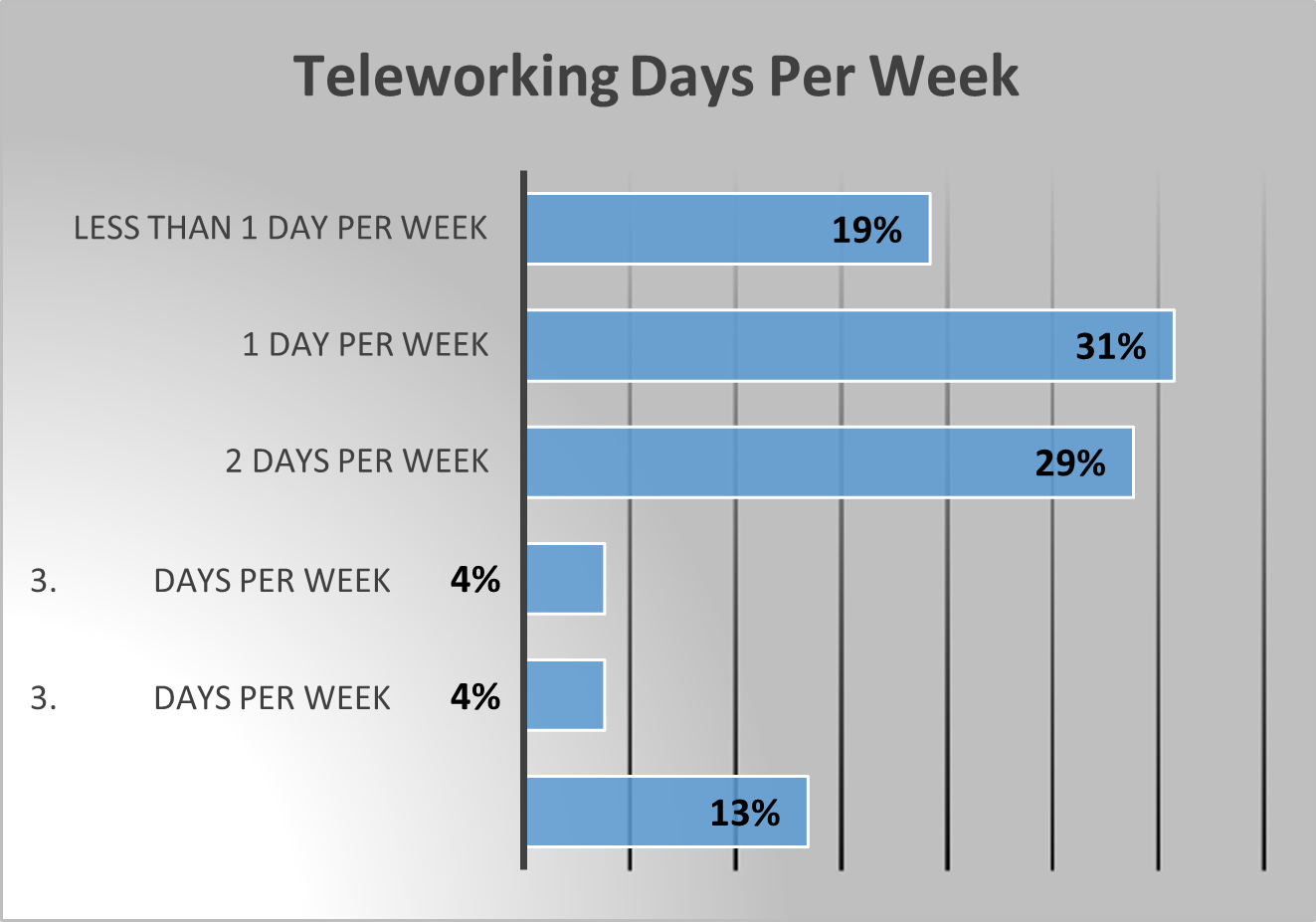
- Duration—Remote work arrangements may vary from allowing employees to work remotely most or all of the time, or only on certain days or parts of the day. The following graph reflects the amount of time that state agencies and higher education institutions reported that their employees spend teleworking:
Days per Week Agency Employees Telework
Source: 2014 DIR Telework Survey[13]
Confidentiality and Security—Will employees be
[1] Texas Dept. of Info. Resources, Telework in Texas: http://publishingext.dir.texas.gov/portal/internal/resources/DocumentLibrary/Technology%20Brief%20-%20Telework%20in%20Texas.pdf
[2] Georgetown University Law Center, Flexible Work Arrangements: A Definition and Examples (2006): https://scholarship.law.georgetown.edu/cgi/viewcontent.cgi?article=1009&context=legal
[3] Texas Dept. of Info. Resources, Telework in Texas: http://publishingext.dir.texas.gov/portal/internal/resources/DocumentLibrary/Technology%20Brief%20-%20Telework%20in%20Texas.pdf
[4] Id.
[5] EEOC, Work at Home/Telework as a Reasonable Accommodation (2003), available at https://www.eeoc.gov/laws/guidance/work-hometelework-reasonable-accommodation
[6] Tex. Gov’t. Code Section 658.005(a)-(c).
[7] Tex. Gov’t Code Section 658.007(a).
[8] Tex. Gov’t. Code Section 658.010(a).
[9] Tex. Gov’t. Code Section 658.0101(b).
[10] Texas Dept. of Info. Resources, Telework in Texas: http://publishingext.dir.texas.gov/portal/internal/resources/DocumentLibrary/Technology%20Brief%20-%20Telework%20in%20Texas.pdf
[11] Telework Basics, https://www.telework.gov/federal-community/telework-employees/telework-basics/
[12] Id.
[13] Texas Dept. of Info. Resources, Telework in Texas: http://publishingext.dir.texas.gov/portal/internal/resources/DocumentLibrary/Technology%20Brief%20-%20Telework%20in%20Texas.pdf